Types of Psycology. A Friendly Guide to Understanding Human Behavior
Published: 7 Mar 2026
Have you ever been curious why people behave the way they do? Why do some people have aggressive personalities while others are peaceful and avoid arguments. Or why the decisions of groups are different from the decisions made by individuals. That is the wonderful world of psychology at work. Psychology is not just about getting therapy sessions and counseling. It is the thorough study of behavior and mental processes and it is divided into many branches each focusing on a different perspective of human life.
For someone who is curious about human behaviour and types of psychology can help them to understand the world better. In this article we will explore the major types of psychology and its real life applications and why each one is important.
What Is Psychology?
Before we explain the types of psychology we will learn what psychology really is and how it works and what are its impacts on various aspects of human life. Psychology at its roots studies how humans think and feel and why they behave the way they do. It gives keen study of our emotions and our communication skills, our ability to make decisions and even our physical responses to situations of urgency and cheerfulness.Psychology is not adaptable. Imagine someone trying to understand a city by only studying its traffic patterns, he probably will not be able to do so. Similarly, in order to learn more and more about human behavior, psychologists study different areas separately but the perceptions often overlap. That is the reason psychology has grown into multiple specialized branches over the years.
Why There Are Different Types of Psychology
Humans are full of complexities and so is their behavior. The way one person reacts in different situations may be different from how another person deals with specific things. Different types of psychology provide a unique view to study specific aspects of life from what people think to how they behave.
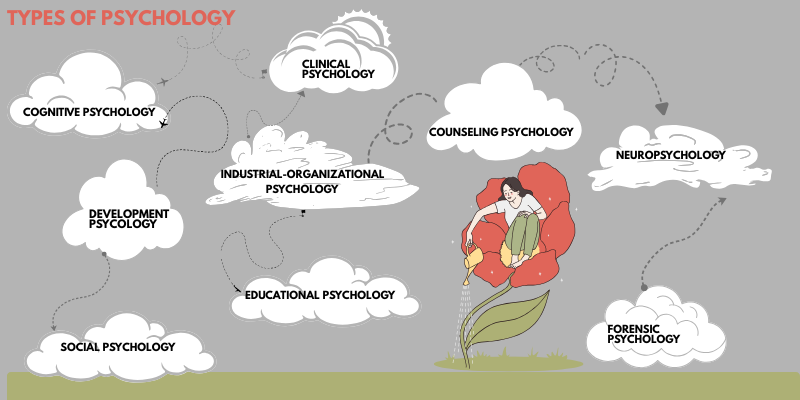
The Main Types of Psychology
Here are the types of psychology. Each one has their own meaning and practical effects and also can influence how we live or work and relate to others.
1. Clinical Psychology
Clinical psychology is the type of psychology that focuses on understanding,diagnosing and treating mental health challenges including depression or anxiety and bipolar disorder and schizophrenia. The psychologist works with individuals, family and groups to help with issues such as depression , anxiety , family problems, relationship problems, stress and life transition . For example: if someone is dealing with stress for a long time such as academic stress that causes severe effects on their work and relationships, a clinical psychologist can help them to identify what causes the stress and suggest practical ways to manage and reduce it. Clinical psychology is also closely related to therapy methods like cognitive behavioral therapy (CBT) and psycho analysis. For Example: A person facing panic attacks may work with a clinical psychologist to understand triggers and learn coping mechanisms.
Applications: therapists or counselors and hospital psychologists and research roles etc.
2. Cognitive Psychology
Cognitive psychology gives keen study of how people think, learn and remember. It explores mental processes like memory or problem solving and decision making and language.This type of psychology helps answer questions like:
- Why do we not remember things?
- How do we solve problems creatively?
- What affects our decision making?
For example: When you convince yourself to buy something cognitive psychology studies the mental process behind your choice including risk estimation and our ability to remember things and pay attention.
Applications: Research roles or human computer interaction and educational content design etc.
3. Developmental Psychology
Understanding why roasters throw hysterics or how teenagers develop identity is all part of developmental psychology.Developmental psychology studies how people grow and change from birth through old age. It looks at emotional and social and cognitive and physical development. For example: a psychologist figures out how children learn language from ages 2 to 5. They observe how fast they learn when they read daily. Their vocabulary becomes stronger day by day while some of them catch up later. Psychologists use these observations to learn cognitive and social psychology in early childhood.
Applications: parenting guidance and early childhood education and elder care etc.
4. Social Psychology
Social psychology studies how individuals control and are influenced by others. It explains groups behavior or social perception and conformity and relationships.For example:have you ever appreciated someone because everyone else did? That is social psychology in action impacting someone’s behaviour. Experiments like Solomon’s ash conformity study or Stanley Milgram’s obedience experiment are classical experiments that show how social influence affects behaviour.
Applications: marketing and conflict resolution Applications : leadership and social campaigns etc.
5. Educational Psychology
Educational psychology is all about exploring everything and gaining knowledge about them. It explores how people gain knowledge, hold information and overcome learning difficulties. For example: Teachers using visual helps or give examples from real life to help students remember difficult concepts.
Applications: schools and tutoring programs and learning materials development.
6. Industrial-Organizational (I/O) Psychology
Industrial organizational psychology applies psychological principles to the workplace. It examines employee behavior and motivation and job satisfaction and productivity. For example: A company hiring a psychologist to design a better work environment and improve team dynamics or create fair performance evaluations is applying I/O psychology.
Applications: HR consulting or corporate training and leadership coaching and workplace research etc. .
7. Counseling Psychology
Counseling psychology focuses on helping people to manage life challenges rather than serious mental disorders. It highlights emotional, social, and issues which are related to career. For example: Someone struggling with career decisions may consult a counseling psychologist to explore options and manage stress.
Applications: private practice or schools and career counseling and mental wellness programs etc.
8. Neuropsychology
Neuropsychology studies show how the brain and nervous system cause impact on thinking, emotions and behaviour.Neuropsychologist examine how brain changes affect behaviour,Such as brain injuries, epilepsy and brain tumor ,ADHD and learning abilities etc.This field bridges psychology and neuroscience. For example Neuropsychologists may work with patients recovering from strokes to understand how brain damage affects memory and movement or emotions.
Applications: hospitals or rehabilitation centers and research labs etc.
9. Forensic Psychology
Forensic psychology mixes law and psychology in which we understand criminal behaviour, assessing criminal profiling and explaining suspect mental positions for legal cases. For example: A forensic psychologist could decide whether a suspect is capable of standing trial or help design rehabilitation programs in prisons.
Applications: law enforcement or legal consultancy and correctional facilities etc.
10. Health Psychology
Health psychology is the branch of psychology which studies explain how biological, physical and social factors affect illness and health. It focuses on avoidance and wellness and managing chronic illnesses. For example: Helping people handle stress perfectly to lower the danger of cardiac diseases or teaching patients tactics to stick to a healthy diet involves health psychology laws.
Applications: hospitals, wellness programs and public health campaigns etc.
Additional Branches Worth Mentioning
While the above ten are the most known there are some other particular branches that are popular. They are mentioned as follows:
- Biopsychology: How does biology influence behavior?
- Cross-Cultural Psychology: How cultures organize thoughts and behavior?
- Abnormal Psychology: Study of unstable behaviors and mental disorders.
- Personality Psychology: Understanding individual differences and traits.
- Sports Psychology: Improving athletic performance through mental techniques.
- Experimental Psychology: Using research techniques to explore all psychological processes.
How Understanding Types of Psychology Helps in Real Life.
Knowing types of psychology is not just academic. It helps to understand human behaviour and affects how you respond to certain situations. Here is how:
- Better Self-Understanding: Learn why you behave the way you do.
- Improved Relationships: Social psychology helps you to understand how conflict happens .
- Career Insights: Helps you choose fields like counseling, education or corporate psychology.
- Mental Health Awareness: Understanding clinical and counseling psychology can normalize mental health struggles.
- Problem-Solving Skills: Cognitive psychology helps to improve how you think and make decisions.
Tips for Choosing the Right Branch to Explore
- Curious about human mind & therapy?
Clinical or Counseling Psychology
- Fascinated by learning and teaching?
Educational or Developmental Psychology
- Interested in social dynamics?
Social Psychology
- Love research & brain studies?
Cognitive or Neuropsychology
- Want corporate impact?
Industrial-Organizational Psychology
Remember the best branch for you is the one that syncs with your thinking and aims.
Final Thoughts
Psychology is more than just a subject, it is a perspective through which we can understand ourselves and others . Each branch explains a unique point of view of human behavior and mental processes and social interactions.From understanding why people uphold groups to helping someone manage anxiety or designing a productive workplace. These types of psychology are tools to decode life. Even if you never get a career in psychology, knowing these branches can improve your relationships and ability to make decisions and overall understanding of human behavior.So next time someone asks Why do people act that way? you will have a toolbox of psychological views ready to answer even in everyday situations.





- Be Respectful
- Stay Relevant
- Stay Positive
- True Feedback
- Encourage Discussion
- Avoid Spamming
- No Fake News
- Don't Copy-Paste
- No Personal Attacks
- Be Respectful
- Stay Relevant
- Stay Positive
- True Feedback
- Encourage Discussion
- Avoid Spamming
- No Fake News
- Don't Copy-Paste
- No Personal Attacks
