What are the Research Methods in Psychology?
Published: 17 Apr 2026
Have you ever got a thought about how psychologists figure out why people think,behave and feel the way they do? It’s not only a guesswork-and it’s absolutely not just “common sense.” Behind every insight about human behavior lies a structured technique known as research methods.
Specifically, research techniques in psychology are the equipment and techniques psychologists use to learn human behavior in a scientific way. These methods help turn inquisitiveness into evidence, observations into patterns, and ideas into reliable results..
But the best part is no one tells you the whole story. Each one offers a different lens-and when joined, they provide us a very clearer picture of how the human mind works. Let’s separate them down in a way that actually makes sense.
Why Research Methods Matter More Than You Think
Before getting a deep thought , it helps to understand why they matter. First of all, trying to answer questions like:
- Do you think social media increases anxiety?
- Does lack of sleep affect human memory?
- Are people naturally aggressive, or does the environment shape behavior?
Without proper techniques, answers to these questions would just be opinions. Research methods allow psychologists to:
- Test ideas objectively
- Avoid bias
- Make predictions
- Apply findings in real life (education, therapy, workplaces, etc.)
In short, research methods are what make psychology a science, not just a discussion.
The Big Three: Core Research Approaches
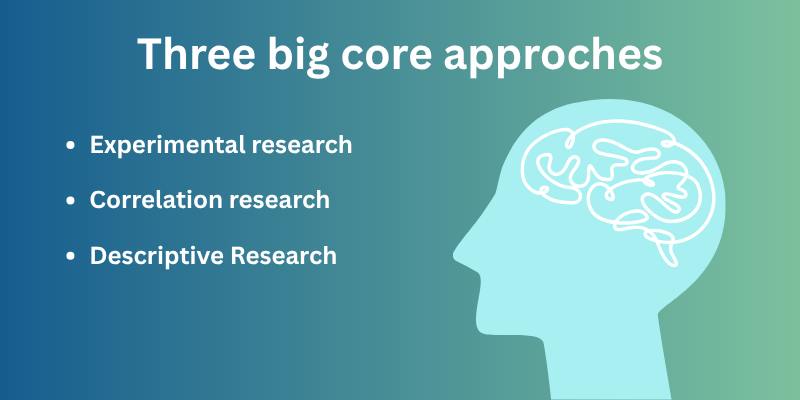
Most psychological research falls into three broad categories:
1. Experimental Research
2. Correlational Research
3. Descriptive Research
Everything else you’ll learn is built on these foundations.
1. Experimental Method: Finding Cause and Effect
If you want to know whether one thing causes another, the experimental method is your best option.In an experiment, a psychologist:
- Changes one factor (called the independent variable)
- Observes what happens to another factor (the dependent variable)
This usually happens in a controlled environment to reduce outside influences.
A SIMPLE EXAMPLE: Let’s say a researcher wants to know if sleep affects memory. They might:
- Give one group 8 hours of sleep
- Give another group only 4 hours
- Test both groups on memory tasks
If the well-rested group performs better, there’s a strong case that sleep impacts memory.
Why It’s Powerful: This is the only method that can clearly show cause and effect.
But There’s a Catch: Real life isn’t always easy to control. Some variables-like emotions, personality, or environment-can’t be perfectly managed. That’s where other methods come in.
2. Correlational Method: Spotting Relationships
Sometimes, you can’t (or shouldn’t) control variables. Instead, you observe how they relate.That’s what correlational research does-it looks for connections between variables.Example:A psychologist studies whether stress and academic performance are related. They might find:
- As stress increases, performance decreases (negative correlation)
- Or both increase together (positive correlation)
Important Insight: Correlation does not mean causation.
Just because two things are related doesn’t mean one causes the other. For example:
- Ice cream sales and drowning incidents both increase in summer
- But ice cream doesn’t cause drowning
Why It’s Useful: Correlational research is great for:
- Studying real-world situations
- Identifying patterns
- Generating ideas for future experiments
3. Descriptive Research: Understanding What’s Happening
Sometimes, the goal isn’t to find cause or relationships-it’s simply to describe behavior as it is.Descriptive research includes methods like:
- Observation
- Surveys
- Case studies
It answers questions like:-
- What do people do?
- How do they behave in certain situations?
Let’s look at these in more detail.
Observational Method: Watching Real Behavior
In observational research, psychologists watch and record behavior without disturbing them.
Types of Observation
- Naturalistic observation: Watching people in real life settings
- Controlled observation: Watching in a structured environment
Example: A researcher might watch children on a playground to learn social interaction.
Why It Feels Real: Because behavior is observed in natural habitat, the results often show authentic human behavior.
Limitation: People might act strangely, if they know they’re being watched.
Survey Method: Asking People Directly
Surveys are one of the most widely used methods in psychology.They involve:
- Questionnaires
- Interviews
- Polls
Example: A psychologist might ask hundreds of people about:
- Their sleep habits
- Stress levels
- Social media usage
Strengths
- Collects large amounts of data quickly
- Cost-effective
Weaknesses
- People may not answer honestly
- Questions can be misunderstood
Still, when designed well, surveys can reveal powerful insights.
Case Study Method: Going Deep, Not Wide
A case study focuses on one person or a small group, studied in great detail. Example: A famous case study might involve someone with a rare brain injury, helping researchers understand how specific brain areas function.
Why It’s Valuable
- Provides rich, detailed information
- Helps explore rare or unusual conditions
The Downside: You can’t always apply findings from one person to everyone else.
Longitudinal Method: Studying Change Over Time
Some questions can’t be answered in a day-or even a year.That’s where longitudinal research comes in. It involves studying the same group of people over a long period.
Example :Tracking children from age 5 to 15 to study cognitive development.
What Makes It Special
- Shows how people change over time
- Helps identify long-term patterns
Challenges
- Time-consuming
- Expensive
- Participants may drop out
Cross-Sectional Method: A Faster Alternative
Instead of waiting years, researchers can compare different age groups at the same time.
Example
Comparing memory skills in:
- Teenagers
- Adults
- Elderly individuals
Benefits
- Quick and efficient
- Less expensive
Limitation
It doesn’t track actual development-just differences between groups.
Psychological Testing: Measuring the Mind
Psychologists often use standardized tests to measure:
- Intelligence
- Personality
- Aptitudes
These tests are carefully designed to ensure:
- Reliability (consistent results)
- Validity (accurate measurement)
Example:IQ tests or personality assessments used in schools or workplaces.These tools turn abstract concepts-like intelligence-into measurable data.
Qualitative vs Quantitative: Two Ways of Seeing Data
Another important distinction in psychological research is how data is collected.
Qualitative Research
- Focuses on experiences and meanings
- Uses interviews, observations
- Produces non-numerical data
Example: Understanding how people feel after a traumatic event
Quantitative Research
- Focuses on numbers and statistics
- Uses experiments, surveys
- Produces measurable data
Example: Measuring how many hours of sleep affect test scores.Most modern research combines both for a more complete understanding.
Ethics: The Backbone of Psychological Research
No discussion of research methods is complete without ethics.Psychologists must ensure:
- Participants give informed consent
- Data is kept confidential
- No harm comes to participants
Why? Because research involves real people-not just data.Ethical guidelines save a pair of the participants and the believability of the research.
So, Which Method Is Best?
Here’s the honest answer: it depends.
- Want to prove cause and effect? → Use experiments
- Want to explore relationships? → Use correlation
- Want real-life behavior? → Use observation
- Want large-scale opinions? → Use surveys
Each technique has power and limitations. That’s why psychologists several times combine multiple methods to get more trustable results.
Final Thoughts
Research methods in Psychology are more than just academic methods-they’re the basics of everything we know about human behavior.They help us move beyond assumptions and actually understand:
- Why we think the way we do
- How our environment shapes us
- What influences our decisions
And perhaps most importantly, they remind us that human behavior is complex. Not only single method can explain it all-but together, they bring us near to the truth.






- Be Respectful
- Stay Relevant
- Stay Positive
- True Feedback
- Encourage Discussion
- Avoid Spamming
- No Fake News
- Don't Copy-Paste
- No Personal Attacks
- Be Respectful
- Stay Relevant
- Stay Positive
- True Feedback
- Encourage Discussion
- Avoid Spamming
- No Fake News
- Don't Copy-Paste
- No Personal Attacks
