What Is the Learning Theory of Psychology?
Published: 11 Apr 2026
Why do you react when your phone buzzes? How did you get a skill to solve math problems, ride a bike and a bicycle, or even trust some people more than others? All of them are not miracles or you get power by birth. None of this happened by accident. These everyday behaviors are shaped by something psychologists have been studying for decades: learning theory.
At its core, learning theory in psychology tries to solve the easy but powerful question-how do we learn? But the answer is anything but simple. It involves behavior, thinking, environment, social influence, and even personal experience.
Understanding Learning Theory (Without the Textbook Feel)
Learning theory is the study of how people and animals gain new knowledge, behaviors, values, or skills through experience. Psychologists frequently explain learning as a relatively permanent change in behavior or mental processes.That phrase “relatively permanent” matters. If you feel exhausted one day and forget something, that’s not learning. But if practice changes how you think or behave long-term, that’s learning.
Think about it this way: Learning isn’t just what happens in a classroom. It’s happening constantly-when you adapt to a new job, develop habits, or even change your opinions.
Why Learning Theory Matters in Real Life
Before diving into the theories, it’s worth asking: why should you care?Because learning theory explains:
- Why habits form (good or bad)
- How teaching methods work (or fail)
- Why children behave the way they do
- How motivation actually works
- And even how social media influences your behavior
Once you understand these patterns, you start noticing them everywhere.
The Four Core Learning Theories You Should Know
Psychologists have examined learning from different perspectives. Each theory emphasizes a different part of the puzzle.
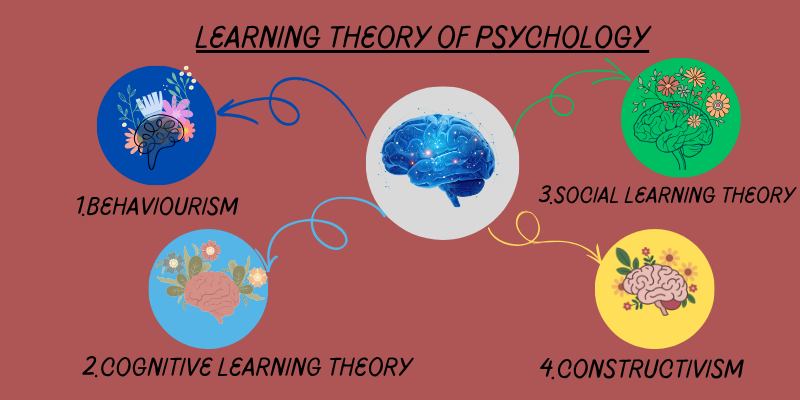
1. Behaviorism: Learning Through Interaction with the Environment
Behaviorism focuses on something very simple: observable behavior. It doesn’t worry about thoughts or emotions-it looks at what people do and how the environment shapes it.Two major figures dominate this theory:
- Ivan Pavlov
- B. F. Skinner
Classical Conditioning (Pavlov)
Pavlov discovered that learning can happen through association.He famously showed that dogs could learn to associate a bell with food. Eventually, the bell alone made them salivate.Now think about your life:
- You feel hungry when you smell food
- You get anxious before an exam hall
That’s conditioning at work.
Operant Conditioning (Skinner)
Skinner took things further and showed that behavior is shaped by rewards and punishments.
- Reward → behavior increases
- Punishment → behavior decreases
For example:You study harder after getting good grades and You avoid touching a hot stove after getting burned.This is why reward systems-like bonuses, praise, or even “likes” on social media-are so powerful.
2. Cognitive Learning Theory: Learning Happens in the Mind
Behaviorism tells us what happens on the outside. Cognitive theory focuses on what’s happening inside your brain.The key idea? Learning is not just reacting-it’s thinking, understanding, and organizing information.A major contributor here is Jean Piaget.
What Makes Cognitive Learning Different?
Instead of memorizing, you:
- Understand concepts
- Connect ideas
- Solve problems
For example:
- Memorizing a formula is behavior-based
- Understanding why the formula works is cognitive learning
This theory changed education completely. It shifted teaching from rote memorization to conceptual understanding.
3. Social Learning Theory: Learning by Watching Others
Now think about how often you learn just by observing people.
You didn’t need formal training to:
- Pick up slang
- Learn social behavior
- Understand cultural norms
That’s where Albert Bandura comes in.
The Core Idea
People learn through:
- Observation
- Imitation
- Modeling
Bandura proved this through experiments showing that children copy behaviors they see-especially from authority figures or role models.
Real-Life Examples
- A child copies parents’ behavior
- A student imitates a teacher’s style
- You adopt habits from your friend group
Social media has amplified this effect. Influencers, trends, and viral content all shape behavior through observation.
4. Constructivism: Learning by Doing and Experiencing
Constructivism promotes a more engaging approach. It proposes that learners are not passive-they actively create their own understanding. One of its key figures here is Lev Vygotsky.
What This Means
Learning happens when you:
- Involve actively
- Ask for questions
- Engage with others
- Apply knowledge in real conditions
Instead of just getting information, you can create meaning from it.
Example:Think about learning to drive:
- Reading rules = basic knowledge
- Actually driving = real learning
This is why practical experience is often better than theory alone.
How These Theories Work Together
Here’s where things get interesting.These theories are not competitors-they complement each other.In real life, learning usually involves all of them:
- You observe someone (social learning)
- You practice and get feedback (behaviorism)
- You understand the concept (cognitive learning)
- You apply it in real situations (constructivism)
Take learning a new language:
- You copy pronunciation (Bandura)
- You get corrected (Skinner)
- You understand grammar (Piaget)
- You practice in conversation (Vygotsky)
That’s learning theory in action.
Common Misconceptions About Learning
Let’s clean up some things that often create a mess in people’s minds.
1. Learning is not just studying
You’re gaining knowledge all the time-even when you’re not want to.
2. Intelligence is not fixed
Learning theories show that environment and experience play a huge role.
3. Rewards always work (not always)
While rewards can motivate, overusing them can reduce internal motivation.
How Learning Theory Applies to Your Daily Life
Once you know these ideas, you start seeing these patterns in everything.
In Education
Teachers use:
- Rewards (behaviorism)
- Concept-based teaching (cognitive theory)
- Group learning (social theory)
In Habits
- Good habits form through repetition and reward
- Bad habits stick because they’re reinforced
In Work and Motivation
- Promotions and bonuses = reinforcement
- Mentorship = observational learning
In Technology
Apps and platforms are designed using learning principles:
- Notifications (conditioning)
- Likes and shares (reinforcement)
- Trends (social learning)
Why This Topic Still Matters Today
Learning theory isn’t just an old psychological concept-it’s more relevant than ever.In a world full of:
- Constant information
- Digital distractions
- Social influence
Understanding how learning works gives you an advantage. It helps you:
- Learn faster
- Build better habits
- Avoid manipulation
- Teach others effectively
Final Thoughts
The learning concept in psychology is more than just a chapter in a textbook. It’s a field through which you can gain knowledge about behavior-your own and others’.From Ivan Pavlov’s experiments with association to Albert Bandura’s insights into imitation, each theory reveals a different layer of how learning actually happens.And the reality is, gaining knowledge isn’t a single process. It’s a mixture of experience, thought, environment, and interaction.Once you start noticing it, you realize something important:






- Be Respectful
- Stay Relevant
- Stay Positive
- True Feedback
- Encourage Discussion
- Avoid Spamming
- No Fake News
- Don't Copy-Paste
- No Personal Attacks
- Be Respectful
- Stay Relevant
- Stay Positive
- True Feedback
- Encourage Discussion
- Avoid Spamming
- No Fake News
- Don't Copy-Paste
- No Personal Attacks
